Table Of Content
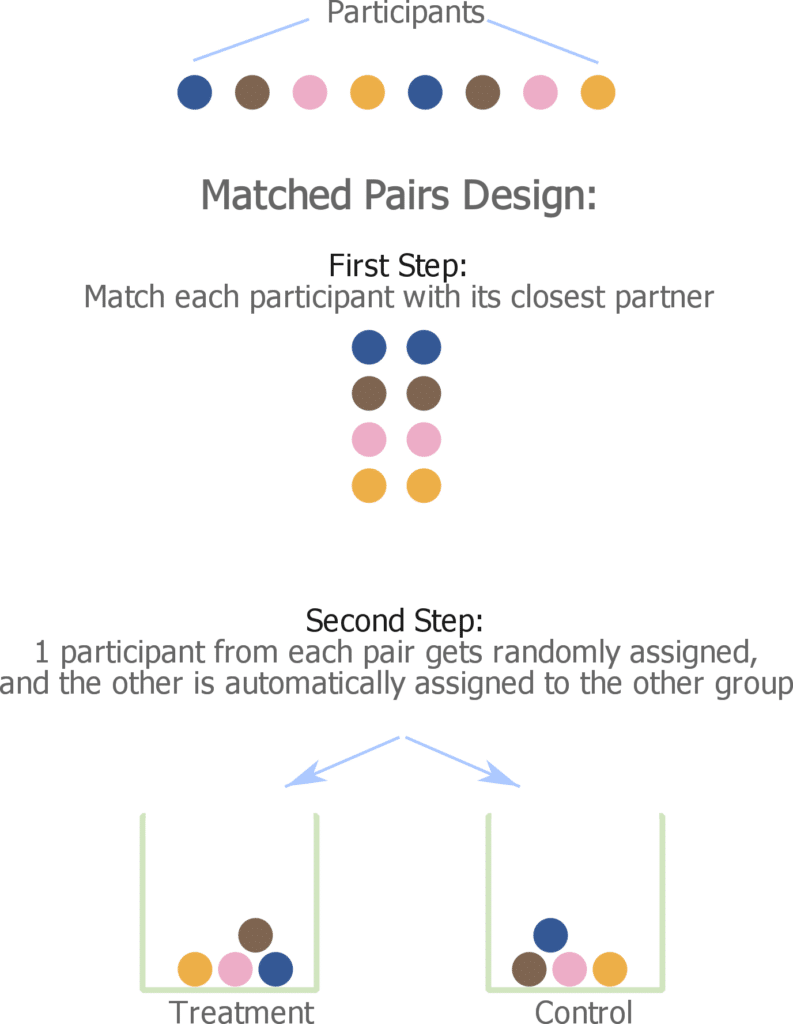
To avoid this issue affecting the results, counterbalancing—an approach that ensures all possible orders of the conditions occur—is used. For instance, half the participants could be asked to read the emotional text first, while the other half reads the descriptive text first. To assess the effect of the organization on recall, a researcher randomly assigned student volunteers to two conditions.
Order effects
It is essential in a between-subjects experiment that the researcher assigns participants to conditions so that the different groups are, on average, highly similar to each other. This matching is a matter of controlling these extraneous participant variables across conditions so that they do not become confounding variables. There are no control groups in within-subjects designs because participants are tested before and after independent variable treatments.
Frequently asked questions about between-subjects designs
The most commonly used type is the single blind, which keeps the subjects blind without identifying them as members of the treatment group or the control group. In a single-blind experiment, a placebo is usually offered to the control group members. Occasionally, the double blind, a more secure way to avoid bias from both the subjects and the testers, is implemented. In this case, both the subjects and the testers are unaware of which group subjects belong to. The double blind design can protect the experiment from the observer-expectancy effect.
Experiment Terminology
With this more manageable population, we can work with the local schools in selecting a random sample of around 200 fourth graders who we want to participate in our experiment. A between-subjects design would require a large participant pool in order to reach a similar level of statistical significance as a within-subjects design. You typically would use a within-subjects design when you want to investigate a causal or correlational relationship between variables with a relatively small sample. Any type of user research that involves more than a single test condition must determine whether to be between-subjects or within-subjects.
Experimental Design in Quantitative Studies
You would then compare the two and see if there were any differences in mental states. In contrast, data collection in a within-subjects design takes longer because every participant is given multiple treatments. However, despite the data collection duration per participant taking longer, you need fewer participants compared to between-subjects design. A dependent variable is what the researcher measures to see how much effect the independent variable had. In our example, the dependent variable is the number of violent acts displayed by the experimental participants.
Avoids carryover effect
This lowers the chances of participants suffering boredom after a long series of tests or, alternatively, becoming more accomplished through practice and experience, skewing the results. Carryover effects are the lingering effects of being in one experimental condition on a subsequent condition in within-subjects designs. These include practice or learning effects, where exposure to a treatment makes participants’ reactions faster or better in subsequent treatments. An experimental design which involves two (or more) groups of participants simultaneously being tested. In the process, the effect of treatments can be measured and assesed by comparing data between groups. One is that each participant has an equal chance of being assigned to each condition (e.g., a 50% chance of being assigned to each of two conditions).
Thus, random assignment plays an important role in within-subjects designs just as in between-subjects designs. Here, instead of randomly assigning to conditions, they are randomly assigned to different orders of conditions. In fact, it can safely be said that if a study does not involve random assignment in one form or another, it is not an experiment. Between subjects design, also known as an independent groups design, is a research method commonly used in experimental and quasi-experimental research. In this design, participants are randomly assigned to different groups, each of which is exposed to a different level or condition of the independent variable.
Adobe groups design apps for iPad in new Adobe Design Mobile Bundle - AppleInsider
Adobe groups design apps for iPad in new Adobe Design Mobile Bundle.
Posted: Tue, 30 Mar 2021 07:00:00 GMT [source]
While a between-subjects design has fewer threats to internal validity, it also requires more participants for high statistical power compared to a within-subjects design. Factorial designs are a type of experiment where multiple independent variables are tested. Each level of one independent variable (a factor) is combined with each level of every other independent variable to produce different conditions. Between-subject and within-subject designs can be combined in a single study when you have two or more independent variables (a factorial design). First, multiple variables, or multiple levels of a variable, can be tested simultaneously, and with enough testing subjects, a large number can be tested.
When the study is within-subjects, you will have to use randomization of your stimuli to make sure that there are no order effects. The principle of random allocation is to avoid bias in how the experiment is carried out and limit the effects of participant variables. A confounding variable could be an extraneous variable that has not been controlled. To compare the effectiveness of two different types of therapy for depression, depressed patients were assigned to receive either cognitive therapy or behavior therapy for a 12-week period. A pre- and post test involves measuring the groups of the study before the treatment and after the treatment. The desire normally is for the groups to be the same before the treatment and for them to be different statistically after the treatment.
You might decide to have the first half of the test users start with site A and have the second half of the users start with site B. However, this is not a true randomization, because it’s very likely that certain types of people are more likely to agree to a study during the weekend and other types of people are more likely to sign up for your weekday testing slots. Individual participants bring in to the test their own history, background knowledge, and context. One may be tired after a long night of partying, another one may be bored, yet another one may have received a great news just before the study and be happy.
You should also use masking to make sure that participants aren’t able to figure out whether they are in an experimental or control group. If they know their group assignment, they may unintentionally or intentionally alter their responses to meet the researchers’ expectations, and this would lead to biased results. The major advantage of this type is it controls for all the threats to internal validity the others ones have. Random assignment is also critical to equally distribute potential confounds—unknown factors that could contribute to the observed results. Researchers don't know everything, so there's always a possbility that additional and unanticpated variables are responsible for an outcome.
Conversations between self and self as Sigmund Freud—A virtual body ownership paradigm for self counselling ... - Nature.com
Conversations between self and self as Sigmund Freud—A virtual body ownership paradigm for self counselling ....
Posted: Thu, 10 Sep 2015 07:00:00 GMT [source]
Participants in all conditions have the same mean IQ, same socioeconomic status, same number of siblings, and so on—because they are the very same people. However, not all experiments can use a within-subjects design nor would it be desirable to do so. User research can be between-subjects or within-subjects (or both), depending on whether each participant is exposed to only one condition or to all conditions that are varied within a study. Random assignment is not guaranteed to control all extraneous variables across conditions. One is that random assignment works better than one might expect, especially for large samples. Another is that the inferential statistics that researchers use to decide whether a difference between groups reflects a difference in the population takes the “fallibility” of random assignment into account.


No comments:
Post a Comment